Showing posts with label culture and tradition. Show all posts
Showing posts with label culture and tradition. Show all posts
Thursday, 9 March 2017
Did you know that some of us are strongly influenced by certain Urban Tribes?
It's hard to accept it at first, but surely you can easily get identified with some of their features. Have a go and try to guess if this happens to you.
These projects and presentations have been designed by some students of I4F.
We hope you like them.

Tuesday, 21 February 2017
Aranjuez

Before going there, it would be nice to have some information about what we are going to see there. It is difficult to think about Aranjuez without some specific music coming to our minds.
Let's watch this video and listen to the music with our eyes closed, to see what it tells to our heart...

 The part that you have just listened to is called the "Adagio", and it is the second movement.
Many musicians have attempted to perform it, but in my opinion,
nobody can beat Paco de Lucía's version, which has brought many people to tears.

In this video, we learn why Joaquín Rodrigo, a blind musician, decided to compose it.
The music you have just listened to is said to be a dialogue between Rodrigo and God, trying to understand why something so tragic had happened to him.
Joaquín Rodrigo and his wife had just lost a child, and she was very ill.
Now, we are going to focus on what we are going to see:

Guia teatralizada - español

Official guide - Spanish and English
 Last, but not least, here is a link to a folder with audios that can serve as a guide to the palace. They are in English, and it would be really advisable to download them and save them onto your mobile phones.
Sunday, 30 October 2016
The Fifth of November
Remember, remember!
The fifth of November,
The Gunpowder treason and plot;
I see no reason
Why the Gunpowder treason
Should ever be forgot!
Guy Fawkes and his companions
Did the scheme contrive,
To blow the King and Parliament
All up alive.
Threescore barrels, laid below,
To prove old England's overthrow.
But, by God's providence, him they catch,
With a dark lantern, lighting a match!
A stick and a stake
For King James's sake!
If you won't give me one,
I'll take two,
The better for me,
And the worse for you.
A rope, a rope, to hang the Pope,
A penn'orth of cheese to choke him,
A pint of beer to wash it down,
And a jolly good fire to burn him.
Holloa, boys! holloa, boys! make the bells ring!
Holloa, boys! holloa boys! God save the King!
Hip, hip, hooor-r-r-ray!
Sunday, 23 October 2016
Friday, 17 June 2016
Tuesday, 19 April 2016
Shakespeare 400th anniversary
The bilingual groups attended to a general presentation about Shakespeare's life and work. The main points that our assintant teacher, Tim, talked were:


- William Shakespeare grew up in a rather important family. His father was influential as an alderman and his mother was the daughter of a wealthy landowner.

- He never received a complete education, but he spent most of his free time reading, writing and acting.

- There are a lot of things we don't know about Shakespeare, but we can hypothesize about parts of his life based on his writings.

- He became very wealthy from the work he did, and bought property in both Stratford-upon-Avon and London.

- Other than his famous stories, he also invented more than 1,700 words by combining words, turning verbs into adjectives, changing nouns into verbs and using many other techniques.
Monday, 4 April 2016
Saint Patrick's Day 2016
Saint Patrick's Day in SIES Luis de Gongora (Loeches)
On March 11, "Irish Treble", an Irish dancing group, together with a folk music band, came to teach us how to dance. They want to spread Irish culture through music and dance, that is why they visit schools showing their performance. They were also invited to the celebration of St. Patrick's Day in Madrid on March 13. They did their best to get us dancing, and some of our students did pretty well. Others... Have a look!!


"Irish Treble" also visited Torrejón on March 16:

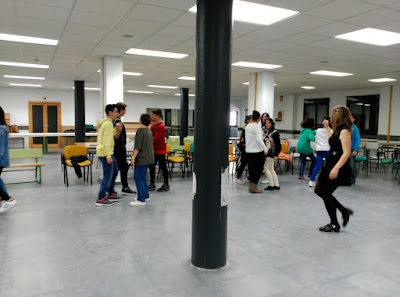


"Irish Treble" also visited Torrejón on March 16:


Monday, 29 February 2016
Where in the World Can You Speak English?
Students worked in groups to research different countries that speak English as their official or native language. Each poster includes cultural information such as food, things to do, festivals, sports and music. Other materials consist of famous people, landmarks, animals and education. The students also gave advice on the best ways to get to their chosen country and what kind of currency you will need while you're there. The posters can now be seen in the "English Corner" in the hallway!
 |
| Scotland and Ireland |
 |
| Nigeria and Jamaica |
 |
| Canada and Wales |
 |
| England, United States, South Africa and the Bahamas |
 |
| The Fiji Islands |
Friday, 12 February 2016
U.S. Version of Carnival
Carnival, but more widely known as Mardi Gras, originated in the French colonies of the southern United States. In the late 17th century, the French King Louis XIV sent a group to protect the country’s claim to the territory of Louisiane, which currently consists of Mississippi, Alabama and Louisiana. Mardi Gras is now celebrated in other areas of the United States, but its most famous location is in New Orleans, Louisiana, due to the origin and growth it encountered from the French colonizers. The first celebration took place on March 3, 1699, just 60 miles from New Orleans.
Mardi Gras in New Orleans consists of floats, parades, music, decorations, costumes and masks. The parade is one of the main staples of the celebrations. Groups spend thousands of dollars and months of labor preparing their floats. Floats can consist of light-hearted themes such as animals, skeletons, jesters and celebrities. Occasionally, the float-builders incorporate political undertones or satirical pieces based on society and culture. It is estimated that about half a million people attend this parade each year. Another famous event is the Masquerada Ball, where all attendees are required to wear masks to hide their identity.
“Fat Tuesday” is the English translation of the French word “Mardi Gras.” It consists of the tradition of eating very rich and fatty foods to prepare for the fasting of Lent. “Fat Tuesday” comes from the Christian calendar that allows for this activity the day before Ash Wednesday. In the United States, the most common food is a paczki, which is deep-fried dough with filling inside. Paczki came from the Poland immigrants and is still being consumed today.
Monday, 1 February 2016
Valentine's Day

The history of Valentine's Day is based on the story of St. Valentine. The story begins in the third century when Emperor Claudius II ruled
over the city of Rome. The emperor believed men made better soldiers if they
were not married, so he decided to ban the act of marriage. Saint Valentine, a
Roman priest, was a romantic and did not agree with the emperor's
decision. Valentine continued to perform
marriages in secret for young couples. He was eventually sentenced to prison and
death by the emperor.

While in prison, Valentine wrote a letter to his love (who was the
jailor´s daughter) and he addressed it “From Your Valentine.” Therefore, he
sent the first ever “valentine.”

In 1537, England’s King Henry VII declared February 14 the official
holiday of St. Valentine’s Day. Today, we still celebrate Valentine’s Day by
gifting cards, flowers, and chocolate to our loved ones. About 1 billion
Valentine’s Day cards are exchanged each year.
More than 35 million heart-shaped boxes of chocolate and 189 million red
roses are sold on Valentines Day.
Check out this video for more interesting facts about Valentine’s Day!
Monday, 25 January 2016
Burns´ Night
On the 25th January, people in Scotland celebrate Burns Night, a celebration of the life and work of Robert Burns, Scotland´s most famous poet. People typically gather for a meal in the evening, sing songs, recite the poetry of Robert Burns and eat Haggis, a traditional Scottish food. Haggis is a pudding containing sheep's heart, liver and lungs, and boiled in its own stomach.

Before the Haggis is eaten, traditionally Robert Burns´ poem "Address to the Haggis" is read. It is written in Scots, a dialect of English.
Sunday, 24 January 2016
The History of Groundhog Day
Groundhog Day is a day celebrated on February 2. According to folklore, if it is cloudy when a groundhog emerges from its burrow on this day, then spring will come early; if it is sunny, the groundhog will supposedly see its shadow and retreat back into its burrow, and the winter weather will persist for six more weeks.
Script of the video
Script of the video
Wednesday, 20 January 2016
Martin Luther King Jr. Day
Martin Luther King Jr. Day
Martin Luther King Jr. (MLK) will be known as one of, if not the most, influential Civil Rights Activists in the United States. Himself and many others during the Civil Rights Movement fought to end segregation that existed among white Americans and African Americans during the mid-1950s until the end of the 1960s. He gained a lot of respect from U.S. presidents and from international leaders. King attended meetings with President Richard Nixon, President Dwight D. Eisenhower, Prime Minister Kwame Nkrumah of Ghana, Indian Prime Minister Jawaharlal Nehru and many of Gandhi's followers
As a Christian minister, Martin Luther King Jr. demanded peaceful protest. He encouraged and joined in on boycotts, marches and sit-ins. Although many law enforcement officers and vigilantes used force to disband civil rights protests, MLK and his followers refused to change their methods. Due to his involvements and actions, he was arrested thirty times in a ten year span. He also received numerous death threats, which resulted in violence to his family and home, and his eventual assassination in 1968.
Martin Luther King Jr. Day is celebrated on the third monday of January every year as a national holiday. He only lived to the age of 39, but his fight against racism and segregation still goes on.
“I say to you today, my friends, though, even though we face the difficulties of today and tomorrow, I still have a dream. It is a dream deeply rooted in the American dream. I have a dream that one day this nation will rise up, live out the true meaning of its creed: "We hold these truths to be self-evident, that all men are created equal."”
- Martin Luther King Jr., Washington D.C., 1963, “The March on Washington”
Friday, 18 December 2015
Have you ever heard of the myth of Theseus and the Minotaur?

If you want to know more about one of the most fascinating myths of the Greek Mythology, click on this link. Jorge Serradilla and Vanesa Ortiz (I1F) have created this awesome Powerpoint presentation.
https://drive.google.com/file/d/0B5V0ghHbZjsXanYtckZOU3pXeHc/view?usp=sharing
Audio (download it): https://drive.google.com/open?id=0BzDeHbIz319wS2xxNzhxTWVzZlU

If you want to know more about one of the most fascinating myths of the Greek Mythology, click on this link. Jorge Serradilla and Vanesa Ortiz (I1F) have created this awesome Powerpoint presentation.
https://drive.google.com/file/d/0B5V0ghHbZjsXanYtckZOU3pXeHc/view?usp=sharing
Audio (download it): https://drive.google.com/open?id=0BzDeHbIz319wS2xxNzhxTWVzZlU
Thursday, 17 December 2015
Merry Christmas (Laila)
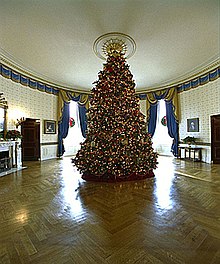
Feliz Navidad! Merry Christmas!
Christmas has always been one of my favorite holidays because it is a great opportunity to spend time with friends and family, eat lots of food, open presents and decorate the Christmas tree. Growing up, we had many Christmas traditions, like baking gingerbread cookies, putting our stockings out for Santa Claus and reading a Christmas poem. This is one of my favorite Christmas poems from my childhood:
By Philip Brooks
Everywhere, everywhere, Christmas tonight!
Christmas in lands of the fir-tree and pine,
Christmas in lands of the palm-tree and vine,
Christmas where snow peaks stand solemn and white,
Christmas where cornfields stand sunny and bright.
Everywhere, everywhere, Christmas tonight!
Christmas where children are hopeful and gay,
Christmas where old men are patient and gray,
Christmas where peace, like a dove in his flight,
Broods o're brave men in the thick of the fight;
Everywhere, everywhere, Christmas tonight!
For the Christ-child who comes is the Master of all;
No palace too great, no cottage too small.
Christmas in lands of the fir-tree and pine,
Christmas in lands of the palm-tree and vine,
Christmas where snow peaks stand solemn and white,
Christmas where cornfields stand sunny and bright.
Everywhere, everywhere, Christmas tonight!
Christmas where children are hopeful and gay,
Christmas where old men are patient and gray,
Christmas where peace, like a dove in his flight,
Broods o're brave men in the thick of the fight;
Everywhere, everywhere, Christmas tonight!
For the Christ-child who comes is the Master of all;
No palace too great, no cottage too small.
Tuesday, 15 December 2015
Thanksgiving in the United States
When I asked the students what important U.S. holiday was approaching, the only response they could think of was “Black Friday.” I was a little surprised at the time until I realized images and videos of "Black Friday" would be more plentiful than those of Thanksgiving.
They learned about dense material such as the way that we currently portray the “First Thanksgiving” with Pilgrims and Native Americans, and the way that it actually occurred. Typically it is shown that both groups are enjoying the company of the others, when actually they were just trying to be tolerant to prevent conflict. Paintings done by U.S. American artists at the time present an idea that the Pilgrims were the ones assisting the Native Americans, instead of a symbiotic relationship.
I also discussed lighter subjects such as Macy’s Thanksgiving Day Parade and the traditional NFL games on played on the 4th Thursday of every November. They easily recognized the parade balloons of Spiderman and Mickey Mouse. Also the students should now know the difference between a rugby ball and an American football, after showing them the Charlie Brown balloon carrying the latter.
Of course the food is one of the most important parts of Thanksgiving, and it seemed that not many were surprised when I showed the amount that U.S. Americans eat on this holiday. Many of the foods can be found here in Spain, but there are also some that are unique to the United States as well.
Below is a short video of the history of how Thanksgiving came to be.
Saturday, 7 March 2015
Saint Patrick's Day
Saint Patrick's Day is a cultural and religious holiday celebrated on 17th March. It commemorates Saint Patrick and the arrival of Christianity in Ireland,as well as celebrates the heritage and culture of the Irish in general. Celebrations generally involve public parades and festivals, céilithe, and the wearing of green attire or shamrocks.
Saint Patrick's Day is a public holiday in Ireland, but it is also widely celebrated by the Irish diaspora. Our school will join this celebration too!
Saint Patrick's Day is a public holiday in Ireland, but it is also widely celebrated by the Irish diaspora. Our school will join this celebration too!
Friday, 27 February 2015


Subscribe to:
Posts (Atom)